



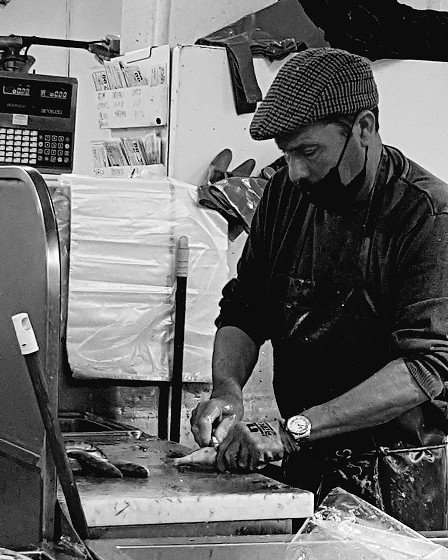
 Photo taken by Chris Morgan 2021 View image
The structure of work is continually changing. The additional challenge of working within the planetary boundaries and regeneration requirements the planet needs, is demanding change that should be transformational. Are business owners and their employees in sync with the change required? Are we seeing the transformational change that both people and the planet needs?
Work is such an important part of society. It is a structure we can link many important things to; social and individual identity, family and social bonds.
The way we earn money allows us to make choices on buying essential and non-essential goods and services.
It provides a routine for our activities, helps with physical and mental wellbeing and self-confidence.
Being without work or stuck with work that is not right for you can be extremely damaging for individuals. The increase in focus of mental health and wellbeing at work is helping to changing that.
The spotlight is also shining on businesses that thrive and create work that is structured around damaging our planet.
Those who aren't interested in a sustainable future, one that not only positively supports the health and wellbeing of our planet and people, but also wants to be part of the regenerative requirement, will decline.
That should feel like a positive step, shouldn't it? Should we worry that the trend to hold on to quarter-on-quarter growth projections and profit expectations will result in more options for technology and not humans? That our current leaders aren't courageous enough to look at this problem creatively and look for different solutions and push back on growth?
"We can't solve problems by using the same kind of thinking we used when we created them.”
Albert Einstein
What happens when we looks back at out own work timeline?
What thoughts and feelings does that exercise generate? Is our view of work today influenced by our past? Can we use it as a frame of reference?
We had a discussion on how we modify our memories every time we replay them, and as a consequence we replay them differently each time.
The model discussed here was The Experience Cube https://clearleadership.com/
We can look at our experience in any given moment as having four elements:
1. Observations – what we can actually see, hear, etc
2. Thoughts – what we believe, what we tell ourselves
3. Emotions – what we are feeling
4. Wants – what we want to happen, what we want to do, goals etc.
Our discussion looked at how "wants" are such a difficult driver of behaviour. Issues surrounding false reality, imposter syndrome and social media can dominate our thoughts and feelings, and it’s important to use a vehicle that enables feeling to be understood.
We explored Transactional Analysis https://theberne.com/therapy/ And Acceptance and Commitment Therapy “The Hexaflex” https://positivepsychology.com/act-model/ Which nicely led into Emotional Intelligence (EQ) in our business leaders and the workforce generally.
How we went through a period where EQ, was more important than IQ but as it became a “thing” or a “noun” it stopped being an activity we practised. Although, a google search on “is EQ still relevant in the workplace?” brought back 207,000,000 results, all first page articles suggesting strongly it is still relevant. Is this what we see in practice?
Why is emotional intelligence such a valued workplace skill? According to one survey of hiring managers, almost 75% of respondents suggested that they valued an employee's EQ more than their IQ. Emotional intelligence is widely recognized as a valuable skill that helps improve communication, management, problem-solving, and relationships within the workplace. It is also a skill that researchers believe can be improved with training and practice.
Verywellmind.com
As we moved into the evening session, with a different group, the discussion started with “innate nature” and if that wasn’t a big enough topic to blow our minds, we asked the question – what is the innate position of humanity?
Here is a link to an article that summarises our conversation better that I can… https://psyche.co/ideas/our-innate-ideas-prevent-us-seeing-what-is-innate-in-human-nature
Weaved in and out of this discussion was the question – “what are we trying to achieve with these sessions?”
Are we looking to change the corporate world? Can we really do something that Mark Carney hasn’t been able to do yet with the connections he has to the most powerful business owners in the world?
https://thewalrus.ca/mark-carney-was-the-worlds-rock-star-banker-now-hes-ready-for-his-encore/
Are we looking at how, as coaches, we can use our coaching practices to influence change?
Is this about how we, as coaches, build coaching businesses that form part of the green economy?
In some way, it’s all of those things. We know that different people will bring different things to the sessions, and we are open to it all having value, whether that be with corporate conversations about ESG and the investor community and the position and influence of coaching and the business of coaching.
The value of different experiences led the rest of the discussion.
The nature of connection being LOVE.
https://www.verywellmind.com/harry-harlow-and-the-nature-of-love-2795255
And the relevance of “fight or flight” and how most of us are in a perpetual state of survival not thrive mode. The pandemic has heightened this, the climate crisis will generate more situations of conflict. This article features in the HR Director…
https://www.thehrdirector.com/features/health-and-wellbeing/achieve-calm-conflict/
How do we create transformative experiences that enable people to thrive and flourish as our working culture changes? There is a difference between change and transformation.
Change is a response to external influences, where modifying day-to-day action achieves desired results. Transformation is about modifying core beliefs and long-term behaviours—sometimes in profound ways—to achieve the desired results.
CIOinsight.com
What is possible?
We talked about how interesting it is that when having these conversations the choice very quickly polarises around democracy versus communism.
Why aren’t we visioning different options?
Kate Raworth has been trying to promote alternative ecumenic system that works within the planetary boundaries, I have chosen a link from the Ellen Macarthur Foundation who are also doing brilliant work on the circular economy…
https://ellenmacarthurfoundation.org/videos/kate-raworth-building-a-thriving-economy
Our discussion went to the questions – are we growing an alternative universe or transforming the eco system that exists?
Again, big questions that an seem insurmountable, so we take it down the view of the individual – what can we do?
We are conscious that in the zoom room we are all privileged. What do we do about that? We can’t suddenly drop our privilege, but we acknowledge it.
We talk about global trends:
- Continued migration to cities for work Population demographics changing in different countries, creating different needs and dynamics
- The continued evolution of smart cities and increased use of technology
- Continuation of LEAN principles in the workplace Trible and even mafia type workplace structures that drive a particular workplace culture
- The belief that the younger know what they want
- An alternative view that the younger generation don’t know what they want
- Our future of work isn’t just a young generational issue
- How the innate nature of nature is regenerative, the ability to heal is in us all
Nina changes the tough stuff necessary to keep leaders’ vision and strategy alive and prosperous, planet and people engaged, healthy, smiling and having fun. Coach, Consultant & Trainer. Contact her when you are ready to make your contribution to changing the world at ninadar.com the first 30 mins are free.
Share


